How Expanded Metal Weight Is Calculated
Understanding the Basics
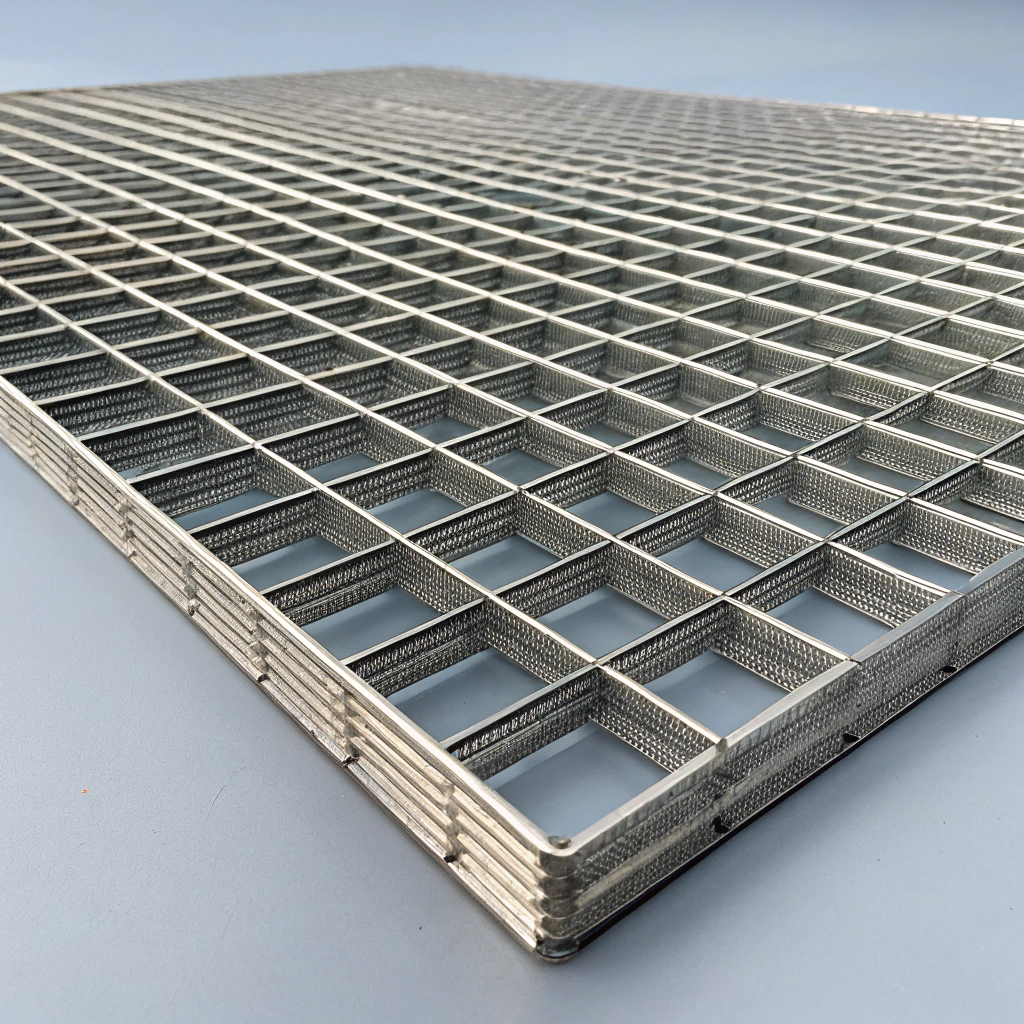
Expanded metal is created by cutting and stretching a solid sheet, producing a pattern of interconnected strands that retain the original material thickness. Because the geometry changes while the material volume stays constant, weight can be derived from the original sheet dimensions, the strand thickness, the material density, and the open‑area percentage of the pattern.
Step‑by‑Step Weight Calculation
- Gather the raw sheet data
- Nominal length (L) in meters
- Nominal width (W) in meters
-
Original sheet thickness (t) in millimeters
-
Determine material density (ρ)
- Typical densities:
- Steel ≈ 7,850 kg/m³
- Aluminum ≈ 2,700 kg/m³
-
Use the value that matches your product specification.
-
Calculate the solid sheet volume
[ V_{text{solid}} = L times W times t times 10^{-3} ]
(The factor converts thickness from mm to meters.) -
Find the open‑area percentage (O%)
- Provided by the manufacturer or measured from the pattern.
-
Example: a 30 % open area means 70 % of the original material remains.
-
Apply the open‑area factor
[ V_{text{expanded}} = V_{text{solid}} times (1 - O%) ] -
Compute the weight
[ text{Weight (kg)} = V_{text{expanded}} times rho ]
Quick Reference Example
- Sheet size: 2 m × 1 m
- Thickness: 3 mm
- Material: Steel (ρ = 7,850 kg/m³)
- Open area: 40 %
[
V_{text{solid}} = 2 times 1 times 0.003 = 0.006 m³
]
[
V_{text{expanded}} = 0.006 times (1 - 0.40) = 0.0036 m³
]
[
text{Weight} = 0.0036 times 7,850 approx 28.3 kg
]
Tips for Accurate Estimates
- Verify the open‑area percentage for each pattern; it can vary significantly.
- Use consistent units throughout the calculation to avoid conversion errors.
- When in doubt, request a sample weight from the supplier to validate your formula.
By following this systematic approach, engineers and procurement teams can quickly estimate expanded metal weight, streamline material planning, and ensure cost‑effective ordering.