How to Calculate Perforated Metal Open Area
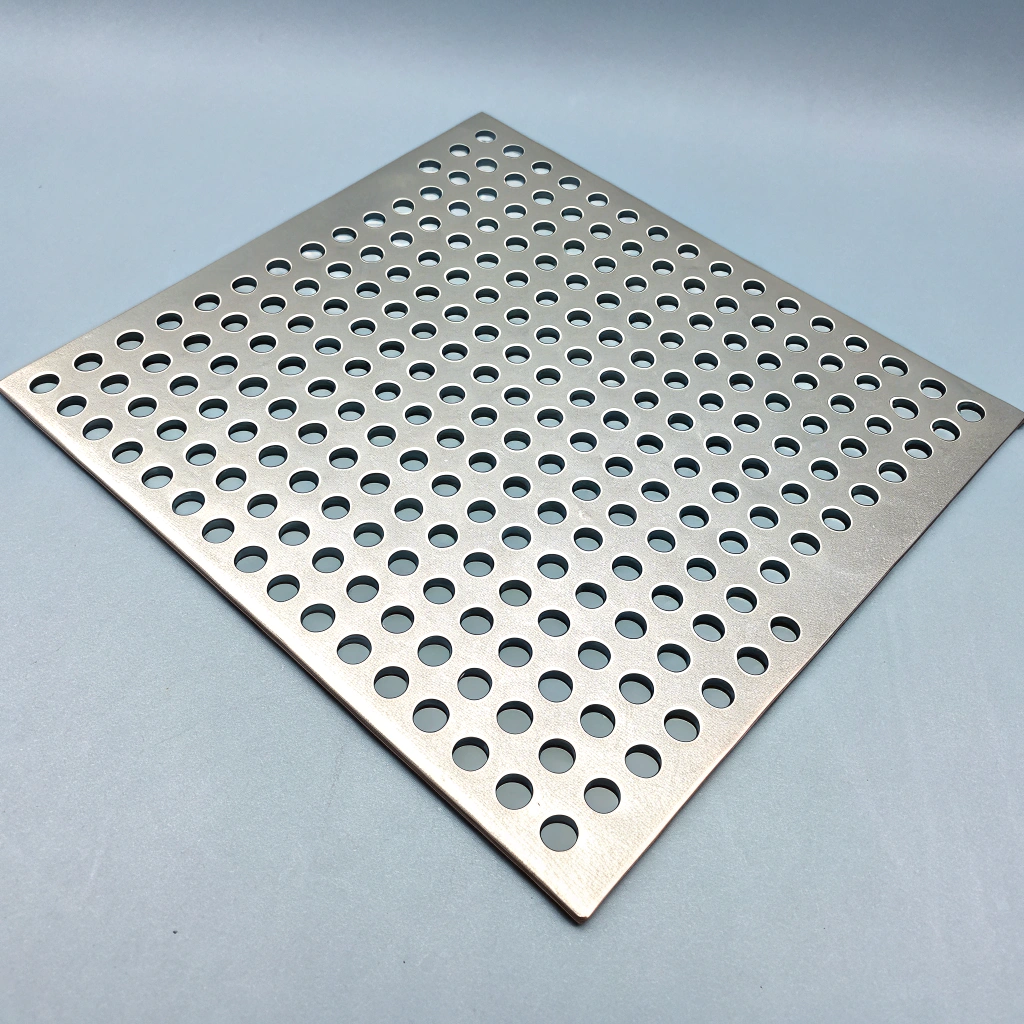
What open area means
The open area of perforated metal is the share of the sheet that is empty, shown as a percentage. It matters for ventilation, filtration, light and sound control. A higher open area passes more air or light but leaves less metal, so strength falls. To choose a target value first, read How to Choose Open Area for Perforated and Expanded Metal.
The core formula
For any repeating pattern:
Open area (%) = (area of one hole ÷ sheet area that belongs to one hole) × 100
The sheet area per hole depends on the pitch (the distance between hole centers) and on the pattern.
- Straight (square grid) pattern: area per hole = pitch × pitch.
- Staggered 60° pattern: rows are offset by half a pitch and the row spacing is pitch × 0.866, so area per hole = pitch × pitch × 0.866.
Ready-to-use formulas
d = round hole diameter, a = square hole side, p = pitch between hole centers.
- Round holes, straight pattern: open area (%) = 78.5 × (d ÷ p)²
- Round holes, staggered 60°: open area (%) = 90.7 × (d ÷ p)²
- Square holes, straight pattern: open area (%) = 100 × (a ÷ p)²
- Square holes, staggered 60°: open area (%) = 115.5 × (a ÷ p)²
- Slotted or rectangular holes, straight pattern: open area (%) = (slot width × slot length) ÷ (pitch across × pitch along) × 100
Worked example: round holes, straight pattern
- Hole diameter d = 10 mm, pitch p = 20 mm.
- d ÷ p = 0.5, and 0.5 squared is 0.25.
- Open area = 78.5 × 0.25 = about 19.6%.
Worked example: round holes, staggered
With the same 10 mm holes at 20 mm pitch, the staggered pattern gives 90.7 × 0.25 = about 22.7%. A staggered layout packs more holes into the sheet, so open area is higher for the same hole size and pitch.
Worked example: square holes, staggered
- Hole side a = 8 mm, pitch p = 16 mm.
- a ÷ p = 0.5, and 0.5 squared is 0.25.
- Open area = 115.5 × 0.25 = about 28.9%.
Check these points before you use a result
- How pitch is defined. Drawings sometimes give the pitch along the row and sometimes the distance between rows. Confirm which one you are using.
- Unperforated margins. The formulas apply to the perforated field. Margins and blank areas lower the figure for the whole sheet.
- Rounded corners and tooling. Real square or slotted holes can have corner radii, which reduce the open area slightly.
- Final values. Open area on a drawing is confirmed per project and producing factory.
Use the calculator for a quick estimate
The Engineering & Calculations page has a perforated metal open area calculator and a perforated sheet weight calculator. Their results are preliminary estimates for planning. Related reading: How to Calculate Perforated Metal Weight.
Related guides
- How to Choose Hole Size for Perforated Metal
- How to Read a Perforated Metal Specification
- Perforated Metal and Perforated Metal Specifications
- Send an enquiry with your hole size, pitch and sheet size.