
- Home
- How-expanded-metal-are-made
How Expanded Metal are made?
Each mesh or panel goes through a process of slitting and stretching metal sheet to form the desired style. The Security Panel has strands and intersecting strands called bonds forming a sharp angle to the original plane of the solid sheet. This process creates the unique pattern and allows a single sheet of metal to be processed into several sheets.


DEFINITIONS
Meshes differentiate by weight and the size of the diamond openings. All meshes are available in Hot Dipped Galvanized or Black Powder coating over zinc primer/zinc e-coating.


TYPES OF EXPANDED METAL
Standard expanded metal is extremely versatile and economical. It comes in a variety of gauge and opening sizes. It’s often used to provide a rigid, raised, slip-resistant surface. In standard expanded metal the strands and bonds are set at a uniform angle. This provides extra strength and rigidity whilst allowing maximum air circulation.

Flattened expanded metal is produced by cold rolling expanded metal to flatten it. It is chosen when a smooth surface is required. The flattening process generally elongates the length of the sheet by 5%

Hexagonal expanded metal has hexagonal openings instead of the usual diamond ones. The hexagonal shape gives the metal extra strength while allowing the passage of air, light, heat, sound and liquid. Hexagonal openings are preferred over diamond openings when the metal is heavily expanded.

Architectural expanded metal features the diamond pattern with added architectural features. The result is a design which combines good aesthetics, increased security and privacy, and improved ventilation. It’s suitable for functional and decorative purposes, or a combination of the two.

Micro expanded metal features small openings in light gauge metal. The openings can be standard, flattened, hexagonal and square. This type of expanded metal is often used in filters.

COMPONENTS OF EXPANDED METAL PROCESS

1. Original Metal Sheet

2. Expanded Metal Sheet
3. Upper blade (moving up and down, and sideways by half a triangle)
4. Lower Blade
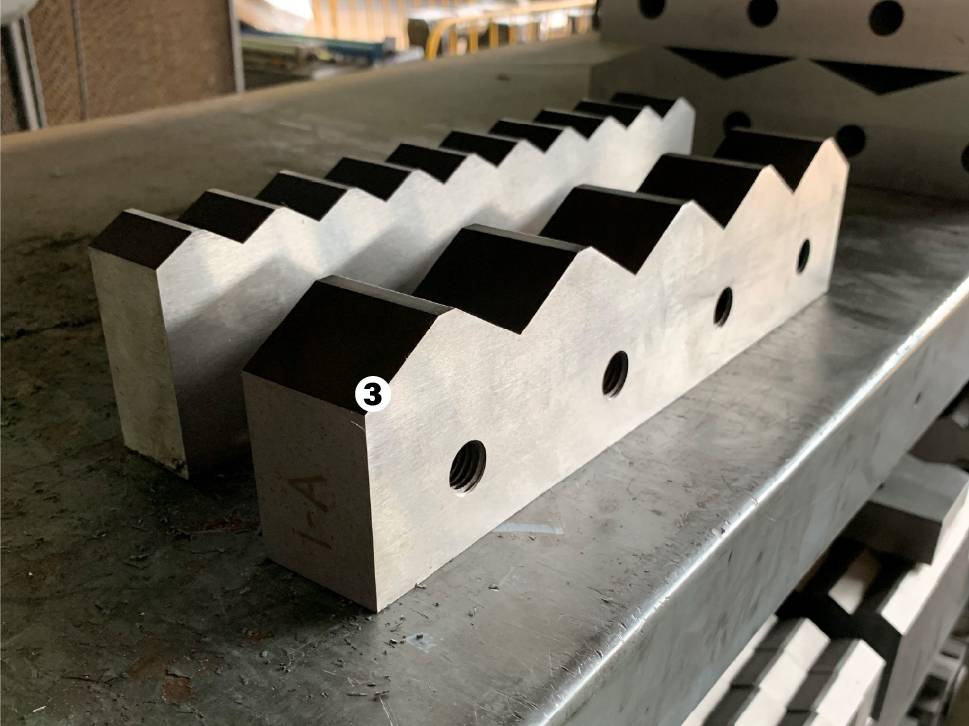
3. Upper Blade
FOUR STEPS IN THE MANUFACTURING PROCESS
The metal sheet advances between the blades one strand width beyond the lower blade.

The upper blade descends to form one half of the diamond design.

The upper blade ascends to its original starting and transverses shift one half of diamond to the side as the metal sheet advances another strand width passing the edge of the lower blade. The upper blade descends again to form another row of half diamonds to complete a full diamond pattern.

The upper blade ascends again to its original starting position, and the cycle continues until the sheet of expanded metal is complete.

Raised vs Flattened

Raised Expanded Metal
Is a finished product as it comes from the press after having been die cut and expanded.

Flattened Expanded Metal
Is a regular raised expanded metal which has been cold rolled, leaving a flat smooth surface. The length of the sheet is elongated usually by 5% while the width stays the same. Strand thickness and Overall thickness are the same.
