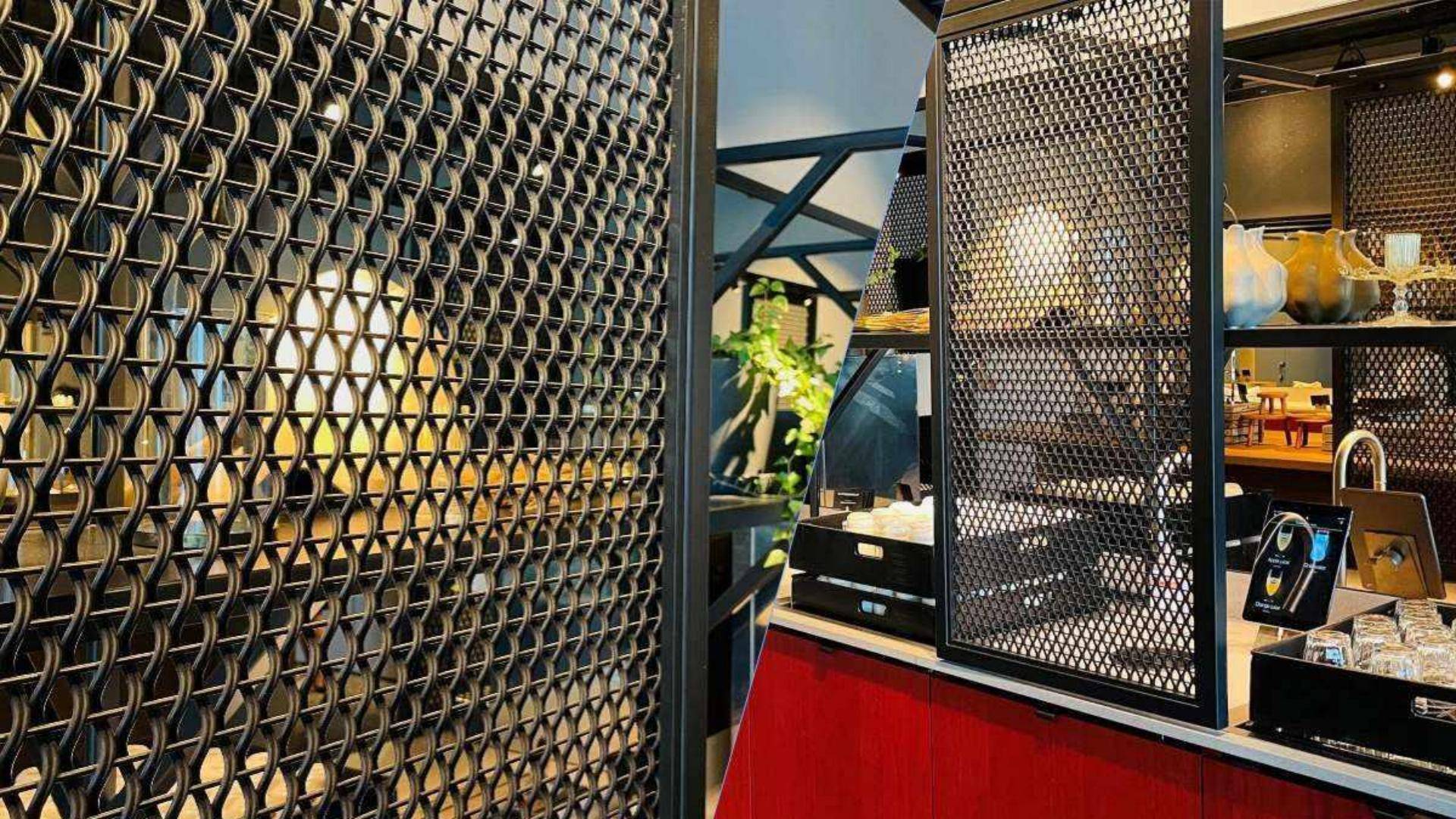
Decorative mesh is metal mesh used where visual appearance is an important part of the application, together with functional requirements such as transparency, screening, light transmission, ventilation, or spatial separation.
Unlike conventional industrial mesh, which is primarily selected for filtration, separation, reinforcement, protection, or containment, decorative mesh is often selected for a combination of:
- Appearance
- Mesh pattern
- Material
- Surface finish
- Transparency
- Light transmission
- Privacy
- Structural requirements
It can be used in both interior and exterior applications, from partitions and ceilings to façades, screens, and architectural features.
Decorative Mesh Is More Than a Visual Element
The term “decorative” does not mean that the mesh is purely ornamental.
Depending on its construction and specification, metal mesh can provide several functions at the same time.
Visual
Mesh pattern, wire diameter, opening size, and finish influence the appearance of the surface.
Spatial
Mesh can define or divide a space without creating a completely solid barrier.
Screening
Mesh can partially screen people, equipment, service areas, or building elements while maintaining some visibility.
Light Control
The open structure can filter light and create changing patterns of light and shadow.
Ventilation
Compared with solid panels, open mesh can maintain airflow.
Architectural Expression
Different materials, weaves, openings, and finishes can create different visual effects.
The appropriate balance depends on the project.
What Is Decorative Mesh Made From?
Decorative mesh can be manufactured from different metals depending on the required appearance, corrosion resistance, strength, and finish.
Common materials include:
- Stainless Steel
- Carbon Steel
- Aluminum
- Brass
- Copper
- Other specialty alloys
Among these, stainless steel is particularly common in architectural and interior applications because of its combination of corrosion resistance, durability, and finish options.
Material selection should always consider the intended environment and required performance.
Common Decorative Mesh Structures
“Decorative mesh” describes an application and design category, rather than one specific manufacturing method.
Depending on the project, decorative metal mesh may include different structures such as:
Woven Wire Mesh
Individual wires are woven together to create regular or specialty patterns.
Welded Wire Mesh
Straight wires are welded at intersections to form a rigid grid.
Expanded Metal
A sheet is slit and stretched to form an open mesh pattern.
Perforated Metal
Metal sheet is mechanically perforated with controlled openings.
Specialty Architectural Mesh
Some architectural systems combine wires, rods, cables, or other elements to create distinctive patterns and visual effects.
Therefore:
Decorative Mesh is a functional and aesthetic category, not a single mesh structure.
Decorative Mesh vs Conventional Wire Mesh
The difference is primarily in design intent and selection priorities.
| Factor | Conventional Industrial Mesh | Decorative Mesh |
|---|---|---|
| Primary purpose | Function | Function + appearance |
| Selection | Performance-driven | Performance + visual requirements |
| Mesh pattern | Usually standardized | Often selected for visual effect |
| Surface finish | Functional | Often highly visible |
| Transparency | Application-dependent | Often important |
| Light / shadow | Secondary | Often part of the design |
| Typical users | Engineers, manufacturers | Architects, designers, contractors |
This does not mean decorative mesh has lower technical requirements.
For many architectural projects, material, dimensions, tolerances, finish, and installation method are all critical.
Decorative Mesh vs Architectural Mesh
These two terms overlap, but they are not always identical.
Decorative Mesh
Usually emphasizes:
Appearance + decorative function
It can be used in architecture, interiors, retail, hospitality, furniture, displays, and other design-oriented applications.
Architectural Mesh
Usually has a broader architectural focus:
Architectural application + functional performance + visual design
Typical applications include:
- Building façades
- Interior partitions
- Ceilings
- Balustrades
- Solar screening
- Building envelopes
- Feature walls
Therefore:
Architectural Mesh can be considered a broader application-oriented category, while Decorative Mesh emphasizes visual and decorative use.
The terminology can overlap depending on the supplier, architect, and project.
We will examine this distinction in detail in Article #02: Decorative Mesh vs Architectural Mesh.
What Determines the Appearance of Decorative Mesh?
Several technical parameters work together.
Mesh Opening
Controls the amount of open area and affects transparency.
Wire Diameter
Changes the visual weight and density of the mesh.
Mesh Pattern
Different weaving or structural patterns create different visual effects.
Material
Stainless steel, aluminum, brass, and copper have different natural appearances.
Surface Finish
Polished, brushed, coated, PVD, and other finishes can significantly change the appearance.
Installation
Orientation, tension, framing, and lighting can change how the mesh is perceived.
This is why a decorative mesh should not be specified simply as:
“Stainless steel mesh.”
A complete specification is usually required.
Where Is Decorative Mesh Used?
Decorative metal mesh can be used in a wide range of applications.
Interior
- Room dividers
- Partitions
- Ceiling features
- Wall panels
- Reception areas
- Retail displays
- Hospitality interiors
Architecture
- Building façades
- Exterior screens
- Solar screening
- Balustrades
- Feature elements
Commercial
- Hotels
- Restaurants
- Retail spaces
- Offices
- Shopping centers
Specialty Applications
- Exhibition displays
- Furniture elements
- Lighting features
- Space separation
The appropriate mesh depends on the required combination of appearance and performance.
Why Choose Metal Mesh Instead of Solid Panels?
Metal mesh can provide several advantages when a project does not require a completely solid surface.
Transparency
Allows partial visibility between spaces.
Light Transmission
Allows natural or artificial light to pass through the mesh.
Ventilation
Maintains airflow through the open structure.
Visual Depth
Creates layered visual effects rather than a flat solid surface.
Lightweight Appearance
A mesh surface can appear visually lighter than a solid metal panel.
Design Flexibility
Different patterns, materials, finishes, and installation methods allow designers to create different effects.
How to Specify Decorative Mesh
For a commercial or architectural project, a useful specification should normally include:
Material
Stainless steel, aluminum, carbon steel, brass, etc.
Mesh Structure
Woven, welded, expanded, perforated, or specialty construction.
Opening
Specify the required opening dimensions or pattern.
Wire / Strand
Specify wire diameter, strand size, or other relevant dimensions.
Finish
Specify the required surface treatment.
Dimensions
Panel or roll width, length, thickness, and other project dimensions.
Installation
Frame, tensioning, fixing, mounting, or other installation requirements.
A complete specification reduces ambiguity when comparing suppliers.
Key Takeaways
Decorative mesh is not simply “metal mesh that looks attractive.”
It is a category of metal mesh where visual design and functional performance are considered together.
The most important variables are:
Application → Structure → Material → Opening → Finish → Installation
Understanding these factors makes it easier to select the right mesh for architectural and interior projects.
FAQ
What is decorative mesh?
Decorative mesh is metal mesh used where appearance is an important part of the application, together with functional requirements such as screening, transparency, light transmission, ventilation, or spatial separation.
Is decorative mesh the same as architectural mesh?
Not exactly. The terms overlap, but Architectural Mesh generally has a broader focus on architectural applications, while Decorative Mesh emphasizes visual and decorative use.
What materials are used for decorative mesh?
Common materials include stainless steel, aluminum, carbon steel, brass, and copper. Material selection depends on appearance, environment, corrosion resistance, strength, and finish requirements.
Can decorative mesh be used outdoors?
Yes. Outdoor applications can include façades, exterior screens, solar screening, and architectural features. Material and surface finish should be selected according to environmental exposure.
Is decorative mesh structural?
It depends on the product and application. Some mesh systems are primarily decorative or screening elements, while others can provide functional or protective performance. Structural requirements should be evaluated separately for each project.
Can decorative mesh be customized?
Many decorative mesh products can be supplied with different materials, mesh patterns, dimensions, finishes, and installation configurations. Customization depends on the specific construction and supplier capabilities.