Introduction
Many industrial processes involve the movement of gases that contain liquid droplets, aerosols, or fine mist particles. If these contaminants are not effectively removed, they can reduce process efficiency, damage equipment, contaminate products, and increase operating costs.
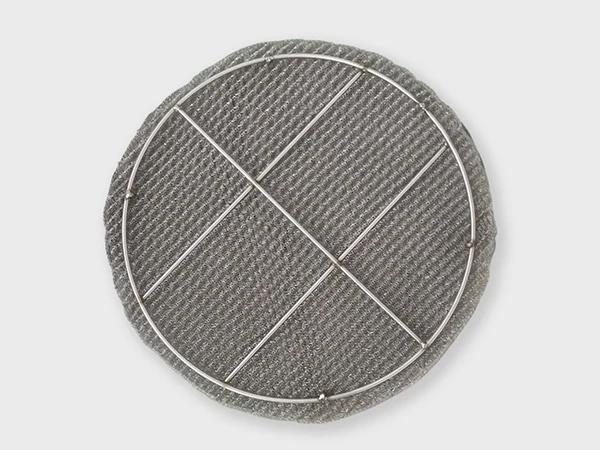
To address these challenges, engineers commonly use knitted wire mesh in gas-liquid separation systems. Thanks to its highly porous structure and large surface area, knitted wire mesh effectively captures entrained liquid droplets while maintaining low pressure drop.
Today, knitted wire mesh is widely used in demister pads, mist eliminators, scrubbers, evaporators, separators, and process towers across industries including petrochemical processing, chemical manufacturing, power generation, and environmental control systems.
What Is Knitted Wire Mesh?
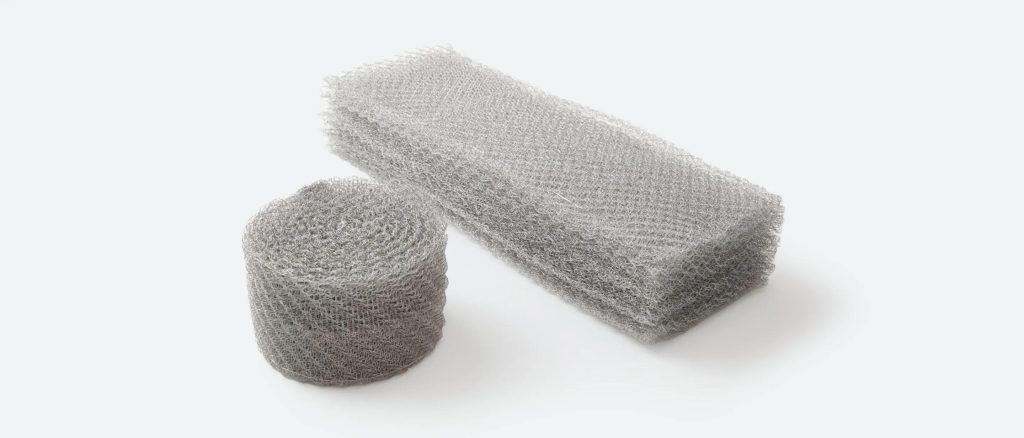
Knitted wire mesh is produced by interlocking metal wire loops into a flexible three-dimensional structure.
Unlike woven wire mesh, knitted mesh creates:
- High void volume
- Large surface area
- Excellent permeability
- Superior droplet capture efficiency
The resulting material is ideal for separating liquid droplets from gas streams.
How Gas-Liquid Separation Works
When gas passes through a knitted wire mesh pad:
- Droplets contact wire surfaces.
- Small droplets coalesce into larger droplets.
- Larger droplets become heavy enough to drain.
- Clean gas continues through the system.
This process is commonly known as:
- Mist elimination
- Demisting
- Gas-liquid separation
Why Knitted Wire Mesh Is Effective
High Collection Efficiency
Knitted mesh can remove a significant percentage of entrained liquid droplets.
Low Pressure Drop
Efficient separation occurs without severely restricting gas flow.
Large Surface Area
The interconnected wire structure promotes droplet coalescence.
Long Service Life
Metal mesh withstands demanding industrial operating conditions.
Demister Pad Applications
The most common application is the demister pad.
Typical Uses
- Separator vessels
- Distillation columns
- Evaporators
- Absorbers
- Scrubbers
Demister pads help prevent liquid carryover and improve process efficiency.
Petrochemical Industry Applications
Refineries and petrochemical facilities frequently use knitted wire mesh in:
Separation Towers
To remove:
- Hydrocarbon droplets
- Condensates
- Process liquids
Gas Processing Units
Applications include:
- Natural gas treatment
- Hydrocarbon recovery
- Process gas purification
Distillation Systems
Demister pads improve product purity and process stability.
Chemical Processing Applications
Chemical plants often use knitted wire mesh in:
- Absorption towers
- Reaction systems
- Process vessels
- Gas cleaning systems
Benefits include:
- Reduced product loss
- Improved separation efficiency
- Lower maintenance costs
Scrubber Systems
Scrubbers remove contaminants from industrial exhaust streams.
Knitted wire mesh is commonly installed to:
- Capture moisture
- Remove fine droplets
- Improve emission control performance
Power Generation Applications
Power generation facilities use knitted wire mesh in:
- Boiler systems
- Emission control equipment
- Flue gas treatment systems
- Cooling processes
Typical Applications Table
| Industry | Application |
|---|---|
| Petrochemical | Mist Eliminators |
| Chemical Processing | Scrubbers |
| Power Generation | Flue Gas Treatment |
| Natural Gas Processing | Gas Separation |
| Environmental Systems | Emission Control |
| Marine Systems | Air Intake Filtration |
Material Selection Guide
Stainless Steel 304
Suitable for:
- General industrial applications
- Moderate operating environments
Stainless Steel 316
Recommended for:
- Corrosive environments
- Chemical processing
- Offshore facilities
Nickel Alloys
Used for:
- High temperatures
- Aggressive chemicals
- Specialized processes
Material Comparison Table
| Material | Corrosion Resistance | Temperature Resistance |
|---|---|---|
| SS304 | Good | Good |
| SS316 | Excellent | Excellent |
| Monel | Excellent | Excellent |
| Inconel | Excellent | Excellent |
Recommended Specifications Table
| Application | Material |
|---|---|
| General Demister Pad | SS304 |
| Chemical Processing | SS316 |
| Offshore Platform | SS316 |
| Petrochemical Plant | SS316 |
| High Temperature Service | Inconel |
| Severe Corrosion Environment | Monel |
Common Specification Mistakes
Selecting Incorrect Material Grades
Chemical compatibility should always be evaluated.
Ignoring Pressure Drop Requirements
Overly dense mesh may increase operating costs.
Underestimating Corrosion Exposure
Aggressive environments require higher-grade materials.
Poor Maintenance Planning
Periodic inspection improves long-term performance.
Knitted Wire Mesh vs Woven Wire Mesh
| Feature | Knitted Wire Mesh | Woven Wire Mesh |
|---|---|---|
| Mist Removal | Excellent | Limited |
| Gas-Liquid Separation | Excellent | Limited |
| Particle Filtration | Moderate | Excellent |
| Flexibility | High | Low |
| Airflow | Excellent | Excellent |
| Separator Applications | Excellent | Limited |
Future Trends in Mist Elimination Technology
Industrial operators increasingly focus on:
- Lower emissions
- Improved process efficiency
- Reduced energy consumption
- Enhanced environmental compliance
Advanced knitted wire mesh systems continue to play a vital role in achieving these objectives.
Conclusion
Knitted wire mesh remains one of the most effective solutions for gas-liquid separation and mist elimination. Its unique structure enables efficient droplet capture while maintaining excellent airflow and low pressure drop.
Whether used in refineries, chemical plants, power stations, or environmental control systems, knitted wire mesh helps improve process efficiency, protect equipment, and reduce operating costs.