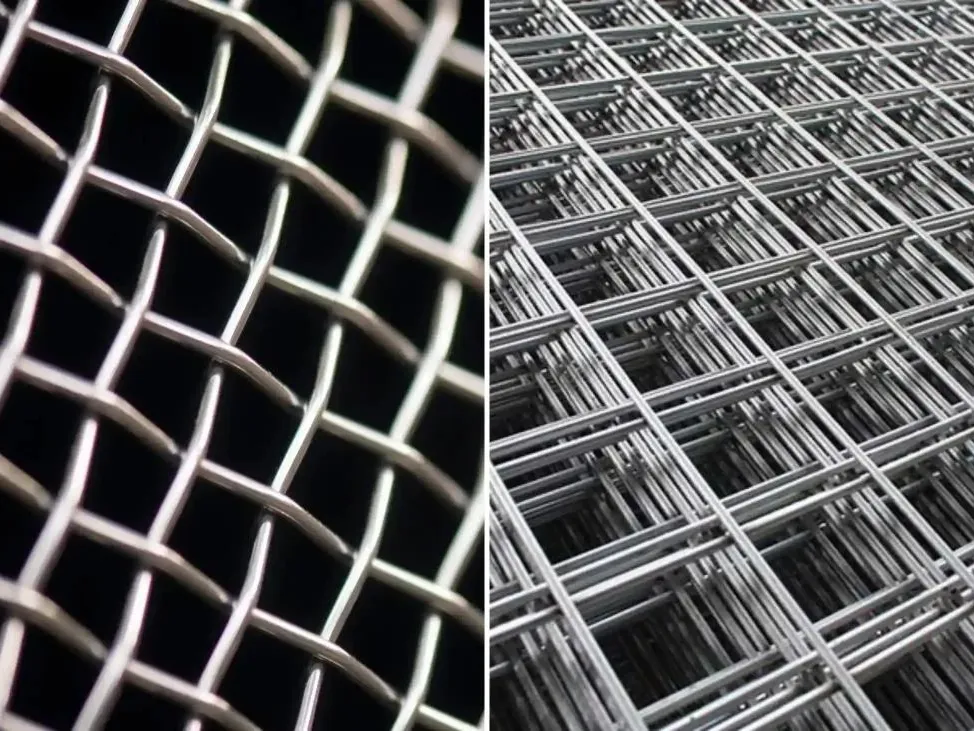
Introduction
Wire mesh is widely used in filtration, screening, fencing, construction, architectural, and industrial applications. Among the many available mesh types, woven wire mesh and welded wire mesh are two of the most common options.
Although both products are manufactured from metal wire and share similar appearances, they differ significantly in structure, performance, cost, and intended applications.
Understanding these differences helps engineers, contractors, and buyers select the most suitable solution for their projects.
What Is Woven Wire Mesh?
Woven wire mesh is produced by interweaving wires in a pattern similar to textile fabric. Common weave types include:
- Plain Weave
- Twill Weave
- Dutch Weave
The result is a flexible mesh structure with highly accurate openings. Typical materials include:
- Stainless Steel
- Galvanized Steel
- Copper
- Brass
What Is Welded Wire Mesh?
Welded wire mesh is manufactured by electrically welding wires at each intersection. The welded joints create a rigid and stable structure. Common materials include:
- Low Carbon Steel
- Galvanized Steel
- Stainless Steel
Welded mesh is widely used where structural strength and dimensional stability are required.
Manufacturing Process Comparison
| Feature | Woven Wire Mesh | Welded Wire Mesh |
|---|---|---|
| Production Method | Interwoven wires | Resistance welded intersections |
| Structure | Flexible | Rigid |
| Opening Accuracy | Very High | High |
| Dimensional Stability | Moderate | Excellent |
| Filtration Capability | Excellent | Limited |
Strength Comparison
Many buyers assume welded wire mesh is always stronger.
The reality depends on the application.
Welded Wire Mesh
Advantages:
- Rigid structure
- Stable openings
- Better load distribution
- Excellent for fencing and panels
Applications:
- Security fencing
- Animal enclosures
- Construction reinforcement
Woven Wire Mesh
Advantages:
- Flexible structure
- Better vibration resistance
- Superior screening performance
Applications:
- Filtration
- Sieving
- Industrial screening
Filtration and Screening Performance
This is where woven wire mesh excels. Benefits include:
- Precise mesh openings
- Fine filtration capability
- High flow efficiency
- Consistent particle separation
Common industries:
- Mining
- Food processing
- Chemical processing
- Pharmaceutical manufacturing
Welded wire mesh is generally not suitable for fine filtration.
Opening Size Range
| Property | Woven Wire Mesh | Welded Wire Mesh |
|---|---|---|
| Fine Mesh Capability | Excellent | Limited |
| Large Openings | Available | Excellent |
| Precision Control | Very High | Moderate |
| Filtration Use | Excellent | Limited |
For extremely fine mesh counts, woven wire mesh is the preferred choice.
Corrosion Resistance
Corrosion resistance depends primarily on material selection rather than manufacturing method.
Common options include:
| Material | Woven Mesh | Welded Mesh |
|---|---|---|
| Galvanized Steel | Yes | Yes |
| Stainless Steel 304 | Yes | Yes |
| Stainless Steel 316 | Yes | Yes |
For corrosive environments, stainless steel remains the preferred material.
Cost Comparison
| Factor | Woven Wire Mesh | Welded Wire Mesh |
|---|---|---|
| Material Cost | Moderate | Moderate |
| Manufacturing Complexity | Higher | Lower |
| Structural Strength | Moderate | High |
| Filtration Value | High | Low |
| Overall Cost | Generally Higher | Generally Lower |
Welded wire mesh often provides the most economical solution for fencing and structural applications.
Typical Applications
Woven Wire Mesh Applications
- Industrial filtration
- Screening
- Mining
- Food processing
- Chemical processing
- Architectural mesh
Welded Wire Mesh Applications
- Security fencing
- Animal cages
- Industrial partitions
- Construction reinforcement
- Storage cages
- Safety barriers
Side-by-Side Comparison
| Property | Woven Wire Mesh | Welded Wire Mesh |
|---|---|---|
| Flexibility | High | Low |
| Rigidity | Moderate | High |
| Filtration Performance | Excellent | Limited |
| Structural Strength | Moderate | High |
| Fine Mesh Capability | Excellent | Poor |
| Cost | Higher | Lower |
| Fencing Applications | Limited | Excellent |
| Screening Applications | Excellent | Moderate |
Which One Should You Choose?
Choose Woven Wire Mesh When:
✓ Filtration accuracy is important
✓ Fine mesh openings are required
✓ Screening performance is critical
✓ Chemical or food processing applications are involved
Choose Welded Wire Mesh When:
✓ Structural rigidity is required
✓ Fencing systems are needed
✓ Construction applications are involved
✓ Budget efficiency is important
Common Buying Mistakes
Selecting Based Only on Mesh Size
The manufacturing method can be as important as the opening size.
Ignoring Application Requirements
Filtration and fencing require completely different mesh characteristics.
Overlooking Material Selection
Corrosion resistance depends largely on the wire material.
Focusing Only on Initial Cost
Performance and service life should be considered as part of the total project cost.
Conclusion
Woven wire mesh and welded wire mesh each offer distinct advantages. Woven mesh provides superior filtration and screening performance, while welded mesh offers greater rigidity and structural strength. Selecting the right product depends on application requirements, operating conditions, and project objectives.